
Uzbek Universities Recognized in Egypt: Accreditation, Public vs Private, and Equivalency
Which Uzbek universities are recognized in Egypt? A sourced guide: why Uzbekistan became a top destination, public vs private universities, accreditation, and equivalency in Egypt.
Uzbek universities recognized in Egypt are now among the most asked-about study options for students from Egypt and the Arab world, especially in medicine. This guide explains why Uzbekistan became a destination, how public and private universities differ, and how accreditation and recognition in Egypt work.
1. Why Uzbekistan became a well-known destination

Photo: Petar Milošević, CC BY-SA 4.0, via Wikimedia Commons
The number of higher education institutions grew from 66 in 2013-14 to 207 in 2025, and about 1.6-1.7 million students now study there, according to the Ministry of Higher Education, Science and Innovation (gov.uz).
The growth came mostly from new private universities after the 2018 licensing rules (WIUT, Uzbekistan TNE review 2026).
UNESCO's country profile describes a system of public, private and foreign-branch institutions (UNESCO profile).
Foreign student numbers are tracked in the national HEMIS data (NQAAE, HEMIS 2025).
2. Public vs private universities
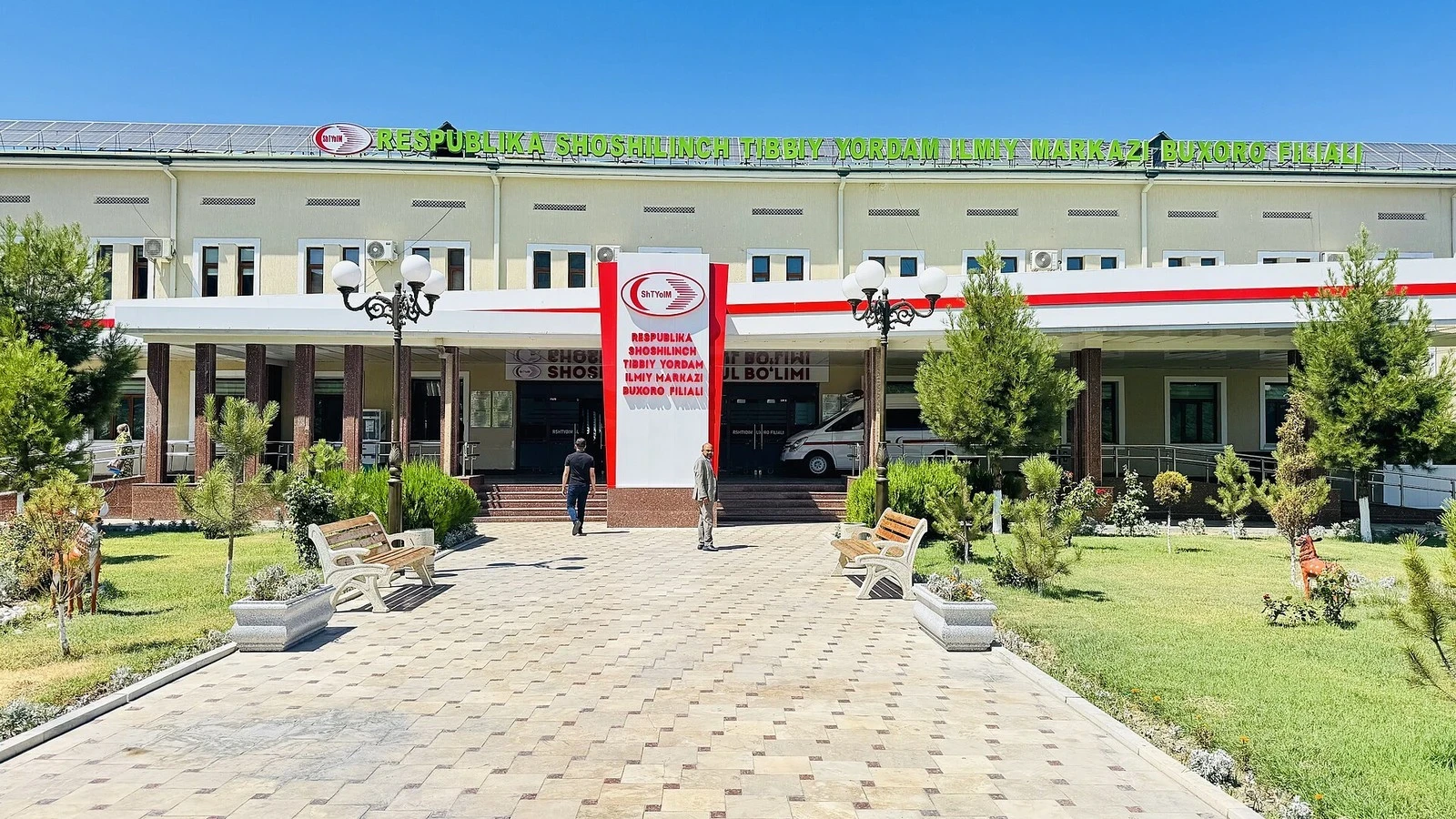
A hospital in Bukhara
Public universities are founded by the state. Private universities work under a state licence and follow the same State Educational Standards (UNESCO profile). The Ministry's figures show about 101 state and 74 private institutions, plus branches (British Council).
So what is the real difference for an international student?
Private universities are built with foreign students in mind. In our experience they understand international students better, move faster on admission and paperwork, and usually teach English better.
Many private medical universities run their own teaching hospital, so clinical practice happens inside the same group. Zarmed University in Bukhara is a private university connected to its own hospital and clinic network (WDOMS F0008519).
Public universities can be strong too. Karakalpakstan Medical Institute is public, listed in WDOMS (F0000700), and received a five-year ECAQA accreditation decision on 20 November 2025 (ECAQA decisions).
All universities in Uzbekistan are accredited and recognized in Egypt. So a private university with its own teaching hospital is the better choice for most international students: it is designed around you, it teaches in a way that suits you, and its clinical training is stronger than at a public university whose teaching is not built for students and whose teaching hospital is weaker. Compare the language of teaching, the clinical training sites, and the support you get before you decide.
3. Accreditation in Uzbekistan
Uzbekistan does not allow any university to operate without full accreditation. Every university needs a state licence (UNESCO profile), and quality accreditation is carried out by the National Agency for Quality Assurance in Education (NQAAE), which keeps a public register (NQAAE register). Open the university's page in the register and check it yourself.
International accreditation is an extra layer. ECAQA is one example: a body that follows WFME guidelines for basic medical education (ECAQA). A WDOMS listing is a directory entry (WDOMS). Ask each university which language of instruction its accreditation covers.
4. Recognition in Egypt

Registan, Samarkand
Are Uzbek universities recognized in Egypt? Yes. Egypt works on mutual recognition of certificates, and accredited Uzbek universities are recognized through the equivalency system of the Supreme Council of Universities (SCU).
How it works in practice:
SCU is the only body in Egypt that equates foreign degrees, through its Equivalency Committee (SCU, Degree Equivalency administration; SCU, Equivalency Committee).
Equivalency is issued for each graduate after graduation. For practical fields such as medicine, SCU requires full-time study. Read the conditions in the SCU FAQs and the equivalency guide 2024 before you travel.
Medicine has a separate step after equivalency: registration with the Egyptian Medical Syndicate.
5. A checklist before you apply
Ask for the university's state licence and open its page in the NQAAE register.
Check the WDOMS entry and the program's language of instruction.
Ask where clinical training happens and in which hospital.
Read the SCU equivalency conditions (secondary-school track, full-time study) before paying.
Keep every document: admission, study invitation, transcripts, attendance.
6. Why students choose Ebt3ath
Ebt3ath is an education consultancy built around international students, with its own technology. We are the official and exclusive agent of Zarmed University in Egypt. Our commission is paid only after the study invitation used for the visa is issued, and our team accompanies students to the embassy.
What sets Ebt3ath apart:
Nas7: our study-path engine that matches your profile to programs.
Fehras: our document-preparation service.
An AI pre-assessment of your file, followed by review from a human counselor.
A partner portal where universities can link their systems so an application reaches them instantly.
Verified, sourced guides like this one, in Arabic and English.
Ebt3ath aims to be the best education consultancy for students heading to Uzbekistan and Europe. Talk to our team and get your file reviewed: ebt3ath.org.
Information checked on 26 November 2026. Rules change; confirm with the official source before you decide.